Tactical interventions to ensure safe passage for cyclists along Bree Street
08 August 2025
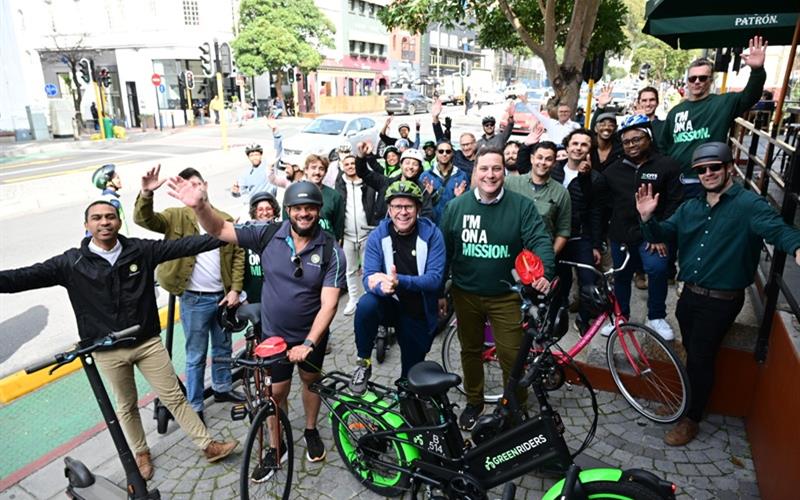
Earlier today the City’s Mayor, Geordin Hill-Lewis, together with Councillor Rob Quintas, the City’s Mayoral Committee Member for Urban Mobility, and the Young Urbanists, tested the new Bree Street Safe Passage cycle lanes in the Cape Town central business district. This pilot project introduces the use of tactical interventions that are easy to implement and adapt in an effort to improve the safety of cyclists along a section of Bree Street.
The Bree Street Safe Passage pilot entails a tactical intervention by the City’s Urban Mobility Directorate in collaboration with the Young Urbanists to improve the safety of cyclists along Bree Street between the intersections of Shortmarket Street and Hans Strijdom Avenue.
The pilot is making use of low-cost materials such as safe-hit bollards and removable concrete slabs to create a barrier between cyclists using the cycle lane, and vehicular traffic.
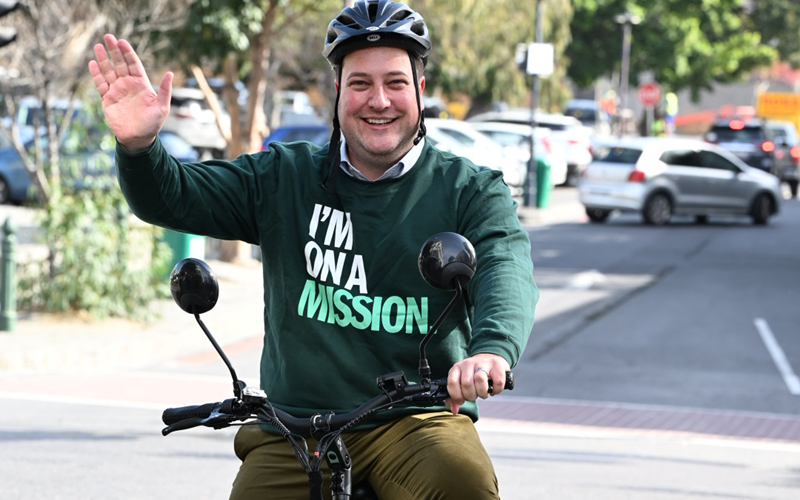
‘It was a pleasure to test the new ways we’re making Bree Street safer for cyclists in partnership with the Young Urbanists. I’m really grateful to them for their advocacy on this. This is a first for the Inner City and the possibilities are exciting because, if it works, we can roll it out to other cycle lanes. The pilot is an example of the City’s collaboration with stakeholders to find innovative and cost-effective solutions. Cyclists count among the most vulnerable road users, and the City is committed to turning the Inner City into a more walkable and cycling-friendly environment. The safer our streets become for pedestrians and cyclists, the more people will choose cycling over private cars. I want to commend the teams who worked on this idea, I definitely felt safe using the lanes today,’ said Mayor Hill-Lewis.
The interventions are quick and easy to implement, test, and remove as these do not require changing the layout of the street, or building work.
‘What makes these interventions so attractive is the fact that it is cost-effective as the current economic environment requires us to do more with less. It also gives us flexibility to pilot new ideas and adapt as we go along. Now that we have the interventions in place, we will monitor the use and fine-tune the pilot over time with adjustments.
‘The safe-hit bollards and delineator kerbs protect the green cycle lane by basically creating a barrier between cyclists and vehicles. We have often seen that the green cycle lane cannot be used because vehicles are double parking across the lane. These interventions will now make it impossible for vehicles to get into the cycle lane.
‘The Safe Passage pilot supports the new Walking and Cycling Strategy that was approved by the City Council in April this year, and confirms our commitment to turning strategies and policies into real change. I also want to thank the Young Urbanists and other private sector stakeholders for their support and enthusiasm in this space. Together, we are mapping a way forward to improve mobility in the CBD by putting people first,’ said the City’s Mayoral Committee Member for Urban Mobility, Councillor Rob Quintas.
‘The Safe Passage Programme, founded by SDI Trust to empower the micro-economy, shows that public-private partnerships can help test and pilot important strategies like the newly passed Walking and Cycling Strategy. Tactical cycling lanes offer protection not only for commuters, recreational cyclists, and – most importantly – last-mile delivery workers like Green Riders, but also help calm traffic, as seen on Bree Street, creating a safer street environment for all road users, including pedestrians.
‘We strongly believe collaboration is key to getting Cape Town moving, and we look forward to working with Urban Mobility to bring more changes to Cape Town’s streets where everyone can feel safe. This is vital to making our children feel safe on our roads and to supporting our growing economy,’ said Roland Postma, Managing Director of the Young Urbanists.
Apart from those cycling to work, and tourists, the pilot will also benefit those who use bicycles for deliveries.
Background information
The tactical interventions have been implemented along Bree Street between the intersections with Shortmarket Street and Hans Strijdom Avenue
The safe-hit bollards and removable concrete slabs or delineator kerbs protect the green cycle lane from abuse and prevent vehicles from entering the lanes or to double park in the lane
The interventions create a barrier between cyclists and vehicular traffic
By improving safety, it is believed that more people will opt for cycling, and contribute to improved air quality, less noise pollution and make Bree Street more accessible to those who are not in private vehicles
This pilot is the first to protect on-street cycle lanes in the CBD and the lessons learnt will be used in roll-outs to other parts of the city
The next phase will be focusing on the cycle lane from Shortmarket Street to Hertzog Boulevard. This phase will also address one of the biggest challenges, namely how to protect a cycle lane that is located next to on-street parking bays.
Caption 1: The City’s Mayor, Geordin Hill-Lewis, tested the new Bree Street Safe Passage cycle lanes in the Cape Town central business district earlier today.
Caption 2: The interventions intend to improve the safety of cyclists along Bree Street between the intersections of Shortmarket Street and Hans Strijdom Avenue. Safe-hit bollards and removable concrete slabs create a barrier between cyclists using the cycle lane, and vehicular traffic. A group of cyclists joined the Mayor and the Young Urbanists at the launch, to the far left is Councillor Mikhail Manuel, the Chairperson of the City’s Portfolio Committee on Urban Mobility.
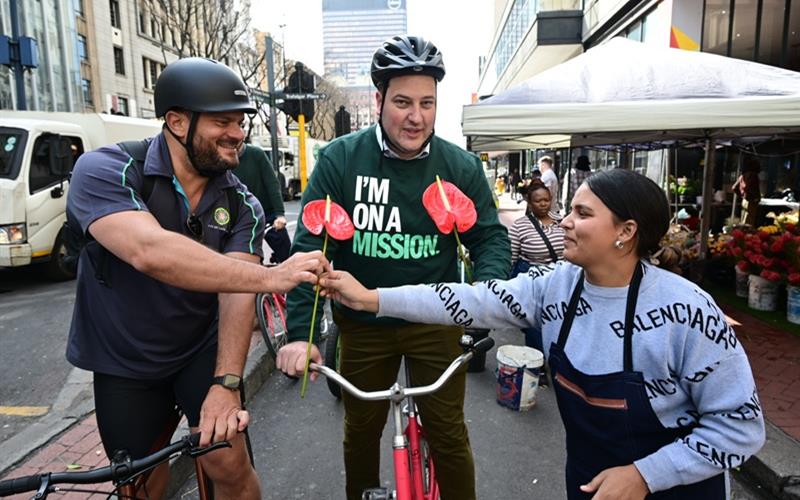
Captions 3: Flower seller Nadia Gamaldien handed over flowers to the Mayor and Councillor Rob Quintas, the City’s Mayoral Committee Member for Urban Mobility, as they were testing the pilot – a tactical intervention by the City’s Urban Mobility Directorate in collaboration with the Young Urbanists.
End
Published by:
City of Cape Town, Media Office